Day 293 of the "What are you reading, and why?" project, and my mom is a new subscriber to One Story, so she has been reading issues 141 and 142, and I got to borrow them from her, so I have also read these two fabulous short stories: "Nephilim," by L. Annette Binder, and "Housewifely Arts," by Megan Mayhew Bergman.
I love the idea of this tiny print journal--one story per issue, saddle stapled, chapbook style. At the One Story website, you can discuss the stories, subscribe, get lots of additional information, and learn how to submit. But it's a sweet little print magazine that comes in the mail, like Inch (for short poems and short short fiction) and blink, before it.
Marcus, a new Facebook friend and fellow writer, who lives in Germany, has an interesting stack of books on his desk right now:
The Ballad of the Sad Cafe, by Carson McCullers
Samuel Beckett, The Short Prose
Our Lady of the Flowers, by Jean Genet
Giraffes in Hiding, by Carol Novack
and three by John Hawkes: The Lime Twig, Second Skin, and Travesty
I would love to know from Marcus, why these particular books at this particular time? Which will he read first? Will he read one straight through and then the next, or read around in several at a time?!
Looks like John Hawkes has great admirers and writes lyrically in mystery or thriller mode and also in complex prose resembling a European more than an American sensibility. Is this correct, Hawkes readers?
Giraffes in Hiding looks like a wild ride! And its subtitle is The Mythical Memoirs of Carol Novack, so she must be a goddess! I love this bit of the author's bio at Amazon: "Carol Novack is a writer of sociopolitical neuroerotic rants and raves, poems, prose poems, and image drenched, lyrical whatnots, and a play." Ah, Genet and Beckett wrote plays, too.
Marcus, do you read a lot of plays?
I am progressing in Other Voices, Other Rooms, by Truman Capote, and found the phrase that is the title on page 100, in the indirect dialogue of the character Little Sunshine, who lives in an old hotel because if he ever "went away, as he had once upon a time, other voices, other rooms, voices lost and clouded, strummed his dreams." And that is a taste of the lovely, lyrical, vaguely mysterious prose style of this particular novel.
I took up this novel to encounter the Idabel Thompkins, who is based on Harper Lee, as I learned in Mockingbird, by Charles J. Shields. I mentioned this in an earlier blog entry, spelling it Tompkins, as I'd found it on page 59 of that book. Imagine my surprise to find it spelled Thompkins in the actual novel. This is one of those moments of mild woe for me, when I ponder the state of print publishing, proofreading, copy editing, entry level jobs, graduates with degrees in English or communications. Sigh....
Fortunately, I write a BLOG, and can make all the errors I want. Or, in most cases, don't want.
And, finally, I am dog-sitting a dog named Wolf.
Showing posts with label Truman Capote. Show all posts
Sunday, November 28, 2010
Thursday, November 25, 2010
Thanking You All!
Day 290 of the "What are you reading, and why?" project, and today I am thanking you all for stopping by my blog since I started this book project, and offering you my goofy State of the Blog Address! And confessing that, yes, I have already started reading Other Voices, Other Rooms, by Truman Capote (a second printing of the first edition, with a little preface by him, and a copy discarded from a school library).
I also offer today one of the beautiful images by Pamela Callahan, a painter I met at Woman Made Gallery in Chicago, who has given permission to share these paintings with you, for which I am so grateful! You can see more at WMG or her website with her husband, Otter Creek Arts.
OK, the State of the Blog Address, a list of the blog entries that have received the most hits! I have watched in amazement and laughter as any blog entry with sex or sports in the title advanced high in the stats! And even more amazement as origami overtook them all. (I think the Christmas shopping season may also be origami season.)
This would be a top ten list, but the monthly stats tell a slightly different story than the all time stats, so I include a few extras:
My Brain is Origami (my brain is origami)
Intercity Volleyball (spiked--heh heh--when we were all looking for scores and standings at state tournament time, but so not about volleyball I fear for the sanity of those who clicked it by mistake)
Of Boobies and Baseball (grand slam in summer, overtaken in fall by volleyball)
Book Burning & Book Banning
Loving Pillsbury (probably involves recipe searches more than architecture)
A Walk in the Cemetery
More Party Girls (uh huh, you know why this is a top hit)
Redneck Yoga (part 2 of an interview with Tim Hunt)
Evening Primrose (just out on DVD, Stephen Sondheim!)
Fault Lines & Risk Taking (stats might be about earthquakes, but it was also added to ISU media site, as part 1 of interview with Tim Hunt)
Lucky Ducks (nobody eats rubber ducks for Thanksgiving)
Sexy Book of Sexy Sex (uh huh, and she knew when she titled her book that it might be popular)
What Would Epictetus Do? (ancient Stoic philosopher comes into his own)
Train Window (partly written "on the road")
Thank you for reading my blog, and feel free to reinforce or upset the statistics by clicking away at anything you like, or like better!
I also offer today one of the beautiful images by Pamela Callahan, a painter I met at Woman Made Gallery in Chicago, who has given permission to share these paintings with you, for which I am so grateful! You can see more at WMG or her website with her husband, Otter Creek Arts.
OK, the State of the Blog Address, a list of the blog entries that have received the most hits! I have watched in amazement and laughter as any blog entry with sex or sports in the title advanced high in the stats! And even more amazement as origami overtook them all. (I think the Christmas shopping season may also be origami season.)
This would be a top ten list, but the monthly stats tell a slightly different story than the all time stats, so I include a few extras:
My Brain is Origami (my brain is origami)
Intercity Volleyball (spiked--heh heh--when we were all looking for scores and standings at state tournament time, but so not about volleyball I fear for the sanity of those who clicked it by mistake)
Of Boobies and Baseball (grand slam in summer, overtaken in fall by volleyball)
Book Burning & Book Banning
Loving Pillsbury (probably involves recipe searches more than architecture)
A Walk in the Cemetery
More Party Girls (uh huh, you know why this is a top hit)
Redneck Yoga (part 2 of an interview with Tim Hunt)
Evening Primrose (just out on DVD, Stephen Sondheim!)
Fault Lines & Risk Taking (stats might be about earthquakes, but it was also added to ISU media site, as part 1 of interview with Tim Hunt)
Lucky Ducks (nobody eats rubber ducks for Thanksgiving)
Sexy Book of Sexy Sex (uh huh, and she knew when she titled her book that it might be popular)
What Would Epictetus Do? (ancient Stoic philosopher comes into his own)
Train Window (partly written "on the road")
Thank you for reading my blog, and feel free to reinforce or upset the statistics by clicking away at anything you like, or like better!
Labels:
Pamela Callahan,
Tim Hunt,
Truman Capote,
Woman Made Gallery
Saturday, July 10, 2010
A Mockingbird Collage
Day 152 of the "What are you reading, and why?" project, and Ginny is re-reading To Kill a Mockingbird, by Harper Lee, because she just read a book of essays about it, how important it was in the lives of various readers, and it made her nostalgic for the classic she had long loved.If you are a reader of this blog, you know I love coincidii (made up Latinesque plural of coincidence.) Here are some coincidii (and extrapolations) pertaining to To Kill a Mockingbird:
1) A young woman in Babbitt's recently fondled and bought the lavender paperback edition of it, as reported in Nostalgic Potpourri.
2) Kim recently pointed out the very same lavender edition in Border's, where we had gone for iced coffee.
3) Seana just wrote about To Kill a Mockingbird in her blog!
4) It is the 50th anniversary of To Kill a Mockingbird, with a new edition out echoing the cover of the first (pictured here).
5) Harper Lee has been almost as silent as J. D. Salinger....(also a topic in this blog and an author in the women's book group I'm in).
6) To Kill a Mockingbird was recently the book chosen by Chicago (and probably other cities) as the book for everyong to read that year.
7) Calpurnia, a crucial character in To Kill a Mockingbird, is also the name of Julius Caesar's wife, which I know from playing Portia, who is Brutus's wife, in Shakespeare's Julius Caesar. Sigh... It's always all about me, isn't it?
Anyhoo, I notice that the brief Amazon review of the book of essays by Mary McDonough Murphy, called Scout, Atticus, & Boo: A Celebration of Fifty Years of To Kill a Mockingbird, advises people to go back to the book itself, which is exactly what Ginny did, but it was the book of essays that inspired her to re-read the original!
The essays are by Oprah Winfrey (who has done a heck of a lot for books with her book club), Alan Gurganus, Wally Lamb, Richard Russo, Tom Brokaw, and Roseanne Cash, among others.
Further coincidii:
8) Ginny was just in Babbitt's, making a fabulous literary collage from Things Found in Books,
9) and so was Kim,
which is how I got my information...
I have to say it was amazing to watch adults get wrapped up in (go into a trance involving glue sticks) making bookmarks. Ginny said she was just encouraging someone else to make one, and then she got hooked. Kim came with kids, one of whom made 4 bookmarks in 5 minutes and then went back outside in search of free frisbees (me following as temporary shepherd), one of whom ignored her, getting wrapped up in the sports books aisle, while Kim herself rummaged through the box of things found in books.
Ultimately, Kim and kids left...and Kim came back, alone, having safely deposited the children elsewhere, to work on her bookmark collage.
I love people! I love books! I love bookmarks! I love collage!
My mom made one, too. A poem collage. My mom rocks.
Wednesday, July 7, 2010
Nostalgic Potpourri
Day 149 of the "What are you reading, and why?" project and today, Garbage Day on my particular street and Hodgepodge Day in my meandering mind, I will report that several random strangers are reading wonderful books they remember from childhood or youth! (These are random strangers in a vintage bookshop, so not entirely random.)A young woman caressed that pale lavender paperback copy of To Kill a Mockingbird, by Harper Lee, saying, "I used to read this over and over, and now I don't think I have it in my house," so she bought it, so she would. The fondness for the book was so sweet, and her nostalgia almost had the aroma of lavender. Plus, that background uncertainty--where is that book?--suggesting various leavetakings from various homes. Sigh....
A man returning to the area for the summer, on break from a professorship in the Middle East, visited the bookshop for old times' sake, bringing his wife and two young children, looking for books from his own childhood to give to his kids--particularly Dr. Seuss, and he found some. Meanwhile, his kids were vocal about their own non-Seuss finds, and he eventually gave in and got 3 books, one for each child, including his "inner child."
And a young man bought 100 Years of Solitude, by Gabriel Garcia Marquez, a nostalgic favorite of mine, because people keep telling him to read it, so now he will. I love that book. I'm holding (well, now I'm typing, but I was holding) my mildly dampstained Avon Books paperback copy, 16th printing, in my cupped hands, as the lovers caress in their intense red and green jungle on the cover. Ah, 100 Years of Solitude. When I least expect it, the beautiful bald girl ascends to heaven in my mind.
And last night, I grew nostalgic for books I don't even have yet!--a paradoxical emotion. Just arrived from Amazon, where it waited on my wishlist till I had saved up, is What Feeds Us, by Diane Lockward, a poet I enjoy every time I find her work in the journals. Finally, I have this book. But her latest, Temptation by Water, is just out, and now I lust after that one. I say "lust" appropriately, I think, as this book seems to be about desire! And water, where I feel at home. And I still desire another Lockward book, Eve's Red Dress
Likewise, I yearn for The Alchemist's Kitchen, by Susan Rich, which sits in my cart till I save up again for poetry! But these two wonderful poets have given us all a treat. Diane interviewed Susan in her own blog, Blogalicious, which you can click on my bloglist, and you can read the interview, a poem, a meditation on the poem, and hear Susan read another poem via a link to youtube! (Or you can click Susan's blog, The Alchemist's Kitchen, on the bloglist, and find her link to the interview. Ah, the wonders of technology. Which reminds me, I signed up for Goodreads but haven't done anything there since. Sigh....)
Bloglists, aka blogrolls, are great. You see the latest entry, and they're so adorably clickable. Blogrolls sound edible.
Sunday, May 9, 2010
Not So Random Strangers
Day 89 of the "What are you reading, and why?" project. A not-so-random stranger--that is, a young man who is familiar to me, because he comes in the store often--is reading some Daniel Quinn. I'm pretty sure the book he chose this time was The Story of B, sort of a sequel to Ishmael, because I remember the snail cover and the subtitle, An Adventure of the Mind and Spirit, but I might be mistaken, as I have been looking at the Daniel Quinn page at Amazon, and now all the covers are vaguely familiar.Like all the people in my town! It's nice to live in a place long enough that all the people look familiar and not like strangers. Oddly, this happens when I return to Chicago for a visit, too. Everybody looks familiar, as do the houses, neighborhoods, and flowers in the median strips, and it's like I never left. Then, say, at the zoo, I will see somebody who looks super familiar, and it will turn out to be somebody from the small town I live in now.
I have not yet read Ishmael, borrowed from my dad because he is modeling a novel structure on it--that is, the kind of novel that is a way to present the author's philosophical ideas. I think it is OK to say that, as I think that is exactly what the both of them are doing, or want to do, and I think my dad is up front about that.
Me, I am 1) not a novelist, though 2) I have the usual novel-in-progress that many writers keep in a drawer/computer file, and 3) every time I look it over, I think, "Hey, I want to know what happens next!" which is 4) probably a good thing, and might mean I actually finish it someday, but 5) probably not, because 6) I no longer believe in linear time, and most people do, and 7) poetry uses a different part of the brain. 7 seems a good place to stop this paragraph.
But I have been musing on that novel as thinly-disguised-autobiography thing again. I hate that! I mean, it's OK, and I am always interested to learn the "where I got that novel" story behind a novel, from the novelist, but thinly disguising one's autobiography, especially when used to snipe at people, just annoys me and seems to lack imagination. Plus, it confuses people, especially aspiring writers, who then think that "Write what you know" just means write a story or novel that is thinly-disguised autobiography. It also confuses readers, some of whom think that every single novel ever written is actually real life with the names changed.
Tony keeps calling In Cold Blood a novel, and Truman Capote is surely a self-absorbed author who did that sniping kind of thing, but he openly sniped, in other works, and In Cold Blood is "a non-fiction novel," a new thing in journalism at the time, about things that really happened, in places and with names that are not fictionalized.
That this kind of thing exists, a hybrid form, surely led the way to the recent confusions involving "fictionalized memoirs," or whatever we should call them--fictions presented in the form of memoirs, because the sensationalism of real life...sells. Sigh.
That said, I notice that Salinger has a persistent dead brother in the background in his fictions, and John Irving, likewise, has motifs of loss and wrestling, and plot patterns, etc. that probably relate in some way 1) to his real life and 2) to bestseller status (repeat what sells), and both of them had to find a way to 1) make a living and 2) live with themselves (or not) while doing it.
I was even reminded at the recent discussion of The Scarlet Letter in Chicago that Nathaniel Hawthorne may have had a dalliance with a woman stikingly like Hester Prynne...which makes him, what, as measly and weak and eloquent and angelic and hypocritical as the Reverend Arthur Dimmesdale? But I can prefer to think that while feminist Margaret Fuller may indeed have been a model for Hester's character, there didn't have to be a dalliance for that to be so.
I can also prefer to believe, about "The Custom-House," the essay that precedes The Scarlet Letter, that Hawthorne really did find a folded-up fabric letter "A," and that this really was the inspiration for the novel! I can prefer to believe almost anything.
Thursday, April 8, 2010
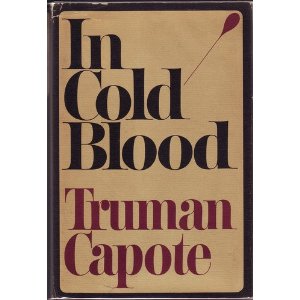
In Cold Blood
Day 58 of the "What are you reading, and why?" project. Tony, aged 58, is reading In Cold Blood, by Truman Capote, for the first time.He is reading it because he recently saw the film Capote. (I think that's the film he was referring to--maybe he saw the film In Cold Blood somewhere. I will follow up on this. In Cold Blood was filmed at the site of the murder, and I remember it as chilling indeed.)
Since today I have to be off and about early and for much of the day, I will pose a question, write a little here, and get back to you.
What I want to know is this: When did you first read In Cold Blood, if you've read it, and did it scare you?
And, of course, why did you read it? (And why and how did it scare you?)
All the accounts, and the film Capote, inform us that Truman Capote wrote the book because he saw a brief news account of a family murdered in their home in Kansas. Since there was no robbery and no clear motive, the article suggested "a pychopathic killer," a phrase attributed to the sheriff. Capote went to Holcomb, Kansas to learn more about the event, the town, the people there, and, of course, the murderers. The novelist Harper Lee went to Kansas with him and helped him communicate with the townspeople and gather the necessary information.
He wrote his famous "non-fiction novel," blending memory, imagination, and "participant observer" reporting. He and it became a sensation.
I was 10 when the film In Cold Blood came out, so I'm pretty sure I didn't see it then. I think I saw it several years later, on television.
But I remember reading the book in my teens when living with my family in a farmhouse out in the country, surrounded by corn and bean fields. I tried not to read it at night, instead taking it out in the yard, in the sunshine, the wind blowing, my dog nearby.
Wednesday, March 31, 2010
Outcasts United Again
Day 50 of the "What are you reading, and why?" project.
First, a short knotted string of coincidences: Sarah Jane reports in a comment that she is reading a collection of essays, edited by Harold Bloom, on Jude the Obscure, the last novel by Thomas Hardy. After that, and the reception of scandalized critics, he wrote only poetry and drama, much of which I just riffled through when a Library of America edition of his works passed through my hands at Babbitt's Books.
Co-worker Jo, a Hardy scholar, and a reader of mysteries, just finished "a police procedural" (a term I wasn't aware of till she spoke it, apparently a kind of mystery focused on what the police do to solve it) by Peter Turnbull and is taking up The Man from Beijing, by Henning Mankell, a mystery set in Sweden and Beijing, among other places.
And Bill, poetry editor for The Hardy Review, and Jo's former professor, just emailed to have me update my bio to publish with 4 poems in the spring issue. The poems touch on Hardy themes of tragic accident, erotic love, intense weather, and biography.
Jude was a social outcast with thwarted dreams of being a scholar,working as a mason instead. (I am tempted to mention the tomes of "secret" Masonic literature we continue to receive at Babbitt's. Which reminds me, inevitably, of Peggy Sue Got Married, immediately lifting the mood to silliness.) And very soon, I will embark on another close reading of The Scarlet Letter, and spend some time Hester the seamstress, another social outcast.
But for now, I'll say that I have finished the "Tale for Two Cities" selection for my twin cities: Outcasts United: An American Town, a Refugee Team, and One Woman's Quest to Make a Difference, by Warren St. John, and look forward to hearing the author speak on April 12 at the fabulous new hotel and conference center in our little town. (This hotel will allow more academic conferences to take place here, where we have two universities.)
The young soccer players in this book are "social outcasts" in America only because they are outwardly different from their neighbors in small-town Georgia, having been cast out from various homelands for various reasons, often experiencing terrible trauma and violence. But soccer gives them a home and a team and a way to bond with others and, eventually, with the larger community.
This is more than a "feel good" story, even if the eventual movie might make it into that, and one certainly does not feel good reading about what has happened to these families before they got to Georgia, nor what they often encountered here. It is a fine and balanced account, resulting from "immersion" journalism (like the "participant observer" journalism of Truman Capote for In Cold Blood, but producing true non-fiction, not Capote's hybrid novel, which my husband is reading right now.)
Having mentioned Rick Bragg and his plagiarism woes earlier in this blog, I was struck by St. John's meticulous and abundant acknowledgements at the back of this paperback edition of the book, and this sentence in particular: "Times bylines usually carry only one or two names, a convention that hardly does justice to the true tally of people who contribute to each story." St. John's true tally is impressive, and he credits all those who helped with articles on The Fugees soccer team published in the New York Times as well as all those who helped with the book emerging from his immersion reporting.
"Reporters, it might be said, scour for facts in the hope of uncovering truths, and while the former may make the page, the latter take root in the mind and heart." St. John then deeply and sweetly thanks the players and families who have clearly taken root in his mind and heart. I was also thinking here of how his objective reporting of the facts allowed me uncover possible truths between the lines, and also to accept a number of complexities and ambiguities that simply can't be easily reported or resolved. They exist.
First, a short knotted string of coincidences: Sarah Jane reports in a comment that she is reading a collection of essays, edited by Harold Bloom, on Jude the Obscure, the last novel by Thomas Hardy. After that, and the reception of scandalized critics, he wrote only poetry and drama, much of which I just riffled through when a Library of America edition of his works passed through my hands at Babbitt's Books.
Co-worker Jo, a Hardy scholar, and a reader of mysteries, just finished "a police procedural" (a term I wasn't aware of till she spoke it, apparently a kind of mystery focused on what the police do to solve it) by Peter Turnbull and is taking up The Man from Beijing, by Henning Mankell, a mystery set in Sweden and Beijing, among other places.
And Bill, poetry editor for The Hardy Review, and Jo's former professor, just emailed to have me update my bio to publish with 4 poems in the spring issue. The poems touch on Hardy themes of tragic accident, erotic love, intense weather, and biography.
Jude was a social outcast with thwarted dreams of being a scholar,working as a mason instead. (I am tempted to mention the tomes of "secret" Masonic literature we continue to receive at Babbitt's. Which reminds me, inevitably, of Peggy Sue Got Married, immediately lifting the mood to silliness.) And very soon, I will embark on another close reading of The Scarlet Letter, and spend some time Hester the seamstress, another social outcast.
But for now, I'll say that I have finished the "Tale for Two Cities" selection for my twin cities: Outcasts United: An American Town, a Refugee Team, and One Woman's Quest to Make a Difference, by Warren St. John, and look forward to hearing the author speak on April 12 at the fabulous new hotel and conference center in our little town. (This hotel will allow more academic conferences to take place here, where we have two universities.)
The young soccer players in this book are "social outcasts" in America only because they are outwardly different from their neighbors in small-town Georgia, having been cast out from various homelands for various reasons, often experiencing terrible trauma and violence. But soccer gives them a home and a team and a way to bond with others and, eventually, with the larger community.
This is more than a "feel good" story, even if the eventual movie might make it into that, and one certainly does not feel good reading about what has happened to these families before they got to Georgia, nor what they often encountered here. It is a fine and balanced account, resulting from "immersion" journalism (like the "participant observer" journalism of Truman Capote for In Cold Blood, but producing true non-fiction, not Capote's hybrid novel, which my husband is reading right now.)
Having mentioned Rick Bragg and his plagiarism woes earlier in this blog, I was struck by St. John's meticulous and abundant acknowledgements at the back of this paperback edition of the book, and this sentence in particular: "Times bylines usually carry only one or two names, a convention that hardly does justice to the true tally of people who contribute to each story." St. John's true tally is impressive, and he credits all those who helped with articles on The Fugees soccer team published in the New York Times as well as all those who helped with the book emerging from his immersion reporting.
"Reporters, it might be said, scour for facts in the hope of uncovering truths, and while the former may make the page, the latter take root in the mind and heart." St. John then deeply and sweetly thanks the players and families who have clearly taken root in his mind and heart. I was also thinking here of how his objective reporting of the facts allowed me uncover possible truths between the lines, and also to accept a number of complexities and ambiguities that simply can't be easily reported or resolved. They exist.
Labels:
Peter Turnbull,
Rick Bragg,
Thomas Hardy,
Truman Capote,
Warren St. John
Thursday, March 4, 2010
Twists of the Screws
Day 23 of the “What are you reading, and why?” project.
Mike is reading L. P. Hartley’s novel The Go-Between, written in the 1950s and set in 1900, before the two world wars. It is a romance and a coming-of-age novel, with mystery and trouble, innocence and awareness. Might remind some readers or filmgoers of Atonement by Ian McEwan.
I first encountered The Go-Between as a film with Julie Christie and probably missed much of what was going on. Same thing happened when I saw The Innocents, the truly scariest film I ever saw as a child, with Deborah Kerr, in black and white, based on Henry James’s short story “The Turn of the Screw,” which I then read to try to figure out what the heck was going on. It’s actually a long short story, a novella. The children are go-betweens in this tale, too. Reading it did not help me understand it any better, but it wasn’t as scary.
Same thing happened when I read Lolita, the wonderful, icky book by Vladimir Nabokov. I saw the black-and-white film with Shelley Winters and couldn’t see what all the fuss was about, read the book and was even more confused. Sometimes I think I am an idiot. (I can’t read plays, either. I have to see them. Or be in them.)
Then one of my college students had the same kind of reaction to Lolita, the book. What was all the fuss about? Meaning, where was the sex? She also watched the film, the newer version. This was part of a research paper assignment on banned books. Tell us why it was banned, what was the outcome of the attempt to ban it, whether you agree or disagree, etc. People really got into it, I am glad to say. In her presentation, my student stressed the lollipop on the cover of the film box.
I should pause here to mention that Rebecca, who is reading Her Fearful Symmetry AND Last Night in Twisted River, is also listening to Reading Lolita in Tehran on CD, or she was when I first asked the question, “What are you reading?” She’s had a couple sick kids and a sick self since then, so I hope she has been resting and pushing fluids, as they say.
Her Fearful Symmetry is by Audrey Niffenegger, who wrote The Time Traveler’s Wife, the first book we read in my local book group. I had met Audrey briefly one summer at Printers Row Book Fair in Chicago, but in her other capacity as a paper maker and paper artist. I enjoyed that book, have not seen the movie version, and hope to read this latest eventually. It appears to be a ghost story, which takes us back to James.
Both Henry James and Edith Wharton spent some time with ghost stories, an ever popular genre, rich with psychological possibility and money-making potential! James had kept ambiguity in the story on purpose, and Truman Capote added another layer of psychological ambiguity as one of the screenwriters for The Innocents. (By the way, a screenwriter for The Go-Between was the notoriously subtle, twisty, rich, and confusing Harold Pinter.) “The Turn of the Screw” was then remade into a completely different film, The Others, with Nicole Kidman, now a sort of psychological thriller ghost story horror film with a war context.
Ah, literature and film, the twists and turns.
Ah, this blog, the twists and turns and screwiness.
Mike is reading L. P. Hartley’s novel The Go-Between, written in the 1950s and set in 1900, before the two world wars. It is a romance and a coming-of-age novel, with mystery and trouble, innocence and awareness. Might remind some readers or filmgoers of Atonement by Ian McEwan.
I first encountered The Go-Between as a film with Julie Christie and probably missed much of what was going on. Same thing happened when I saw The Innocents, the truly scariest film I ever saw as a child, with Deborah Kerr, in black and white, based on Henry James’s short story “The Turn of the Screw,” which I then read to try to figure out what the heck was going on. It’s actually a long short story, a novella. The children are go-betweens in this tale, too. Reading it did not help me understand it any better, but it wasn’t as scary.
Same thing happened when I read Lolita, the wonderful, icky book by Vladimir Nabokov. I saw the black-and-white film with Shelley Winters and couldn’t see what all the fuss was about, read the book and was even more confused. Sometimes I think I am an idiot. (I can’t read plays, either. I have to see them. Or be in them.)
Then one of my college students had the same kind of reaction to Lolita, the book. What was all the fuss about? Meaning, where was the sex? She also watched the film, the newer version. This was part of a research paper assignment on banned books. Tell us why it was banned, what was the outcome of the attempt to ban it, whether you agree or disagree, etc. People really got into it, I am glad to say. In her presentation, my student stressed the lollipop on the cover of the film box.
I should pause here to mention that Rebecca, who is reading Her Fearful Symmetry AND Last Night in Twisted River, is also listening to Reading Lolita in Tehran on CD, or she was when I first asked the question, “What are you reading?” She’s had a couple sick kids and a sick self since then, so I hope she has been resting and pushing fluids, as they say.
Her Fearful Symmetry is by Audrey Niffenegger, who wrote The Time Traveler’s Wife, the first book we read in my local book group. I had met Audrey briefly one summer at Printers Row Book Fair in Chicago, but in her other capacity as a paper maker and paper artist. I enjoyed that book, have not seen the movie version, and hope to read this latest eventually. It appears to be a ghost story, which takes us back to James.
Both Henry James and Edith Wharton spent some time with ghost stories, an ever popular genre, rich with psychological possibility and money-making potential! James had kept ambiguity in the story on purpose, and Truman Capote added another layer of psychological ambiguity as one of the screenwriters for The Innocents. (By the way, a screenwriter for The Go-Between was the notoriously subtle, twisty, rich, and confusing Harold Pinter.) “The Turn of the Screw” was then remade into a completely different film, The Others, with Nicole Kidman, now a sort of psychological thriller ghost story horror film with a war context.
Ah, literature and film, the twists and turns.
Ah, this blog, the twists and turns and screwiness.
Subscribe to:
Posts (Atom)