Showing posts with label Thor's Day. Show all posts

Thursday, June 20, 2024

Joy Sandwich

I am full of joy these days, thanks to Lola, my grandbaby! Here she is in the sky! Later this summer, I will have some time with her in Oregon, helping out while her daddy is off on an adventure. My daughter and I will probably sleep in the family bed together, sometimes with Lola between us, a joy sandwich!!

I get to see my son in Oregon, too! All joy, all the time!

I've been waiting for the tidying impulse to strike me again, and it finally did. I recycled a bunch of old Christmas cards. Not the glitter ones, which I put in the garbage. I don't think glitter can be recycled. I felt a little like I was throwing away Christmas, but I got over it. It was joyful to re-see the cards, re-read some of them, and say bye bye. 

While tidying, I washed and then further aired out in the sun a bunch of overalls my son wore when he was a baby. 


Lola's growing so fast, she might outgrow them before she can wear them--seasonally--but there's a new baby boy cousin in the family, so double-stuff cookie joy sandwich!

And I'm reading a novel that makes me laugh out loud, Sandwich, by Catherine Newman. It's perfect for anyone who's familiar with menopause, children, a wonderful husband who might not always be emotionally available while you are raging due to hormones, and an annual weeklong beach vacation. Also, being of the "sandwich" generation, taking care of kids and parents... I knew when I read a book blurb that I would have to read this one, and tried to wait till my library got it, and ordered a non-fiction book of hers through interlibrary loan in the meantime, and then just gave up and bought it. I laughed out loud during Catastrophic Happiness, too!

So, while I have started tidying again, I have acquired another book. But it's something to keep for gems like this: "People who insist that you should be grateful instead of complaining? They maybe don't understand how much gratitude one might feel about the opportunity to complain." Ha! (as I wrote in my reading journal) Our family in a nutshell! And also for the grandpa's definition/compare/contrast of "schlemiel" and "shlimazel." I won't tell you what it is--buy the book!--but it's on page 104.

Thursday, November 16, 2023

Peacock Crossing

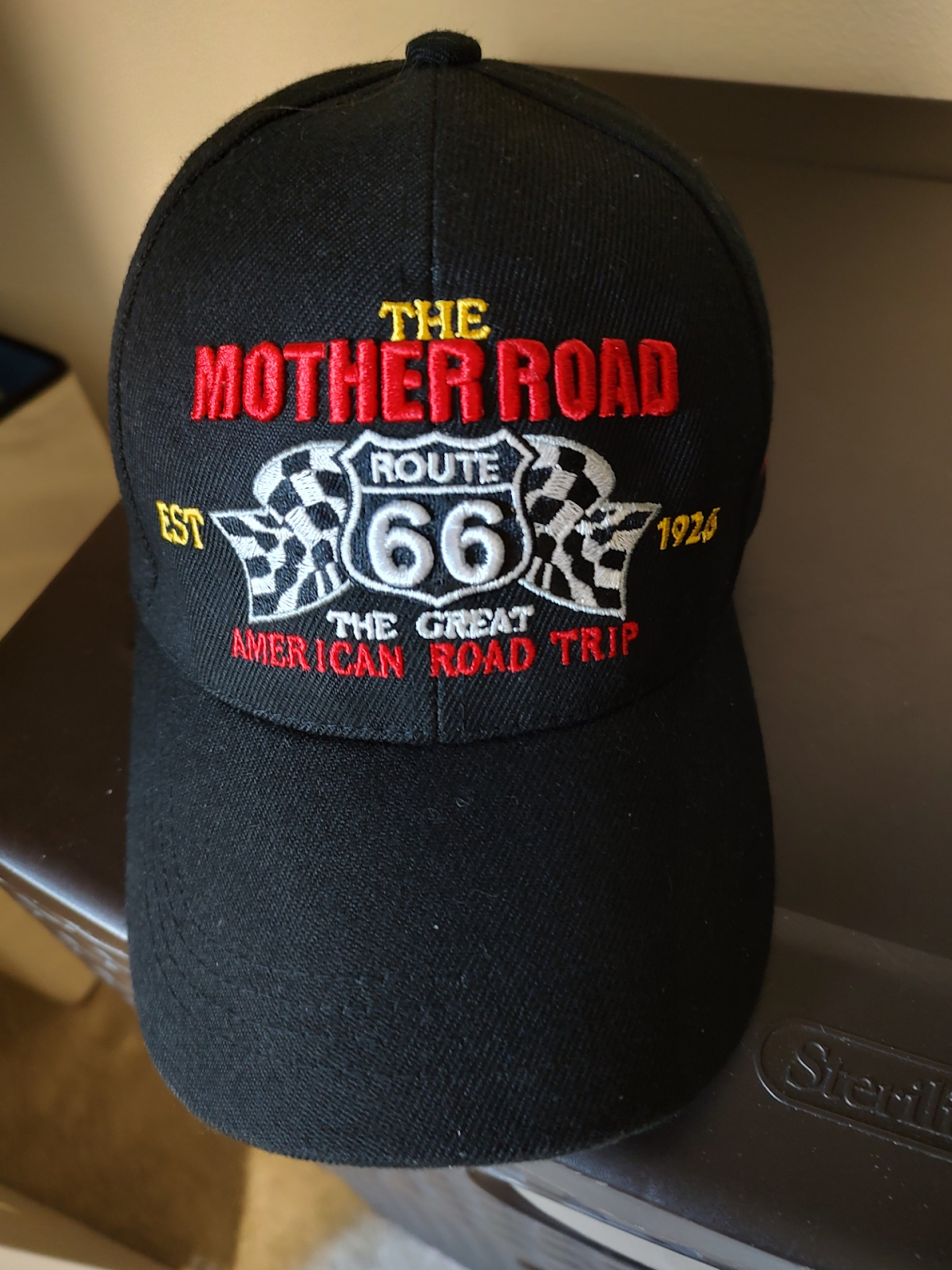
We knew a peacock was crossing the road behind us because a dog was barking at it. Bret turned to look and pointed it out to us, as we prepared to cross the one busy road on our neighborhood walk here in the SE quarter of Portland, OR. Another neighborhood walk is planned for today, a sunny day, timed with the baby's nap after a feeding, as she loves sleeping in the stroller on a jiggly walk. I love being a new grandma. It is helping me continue to accept my mother's death, in part because I am doing the things she did for me, when she came to help with both my babies. I am continuing a motherly tradition, and wearing my Mother Road hat to shield my blue eyes from the sun.

Baby Lola's eyes will probably be brown. Both parents have dark brown hair and brown eyes. But maybe not. Green eyes appear in Bret's family, and Lola currently has auburn hair. His grandpa had dark red hair. Wouldn't that be a delight? 

I had a poem accepted for the Claude Monet issue of Poetry East. It is, of course, a mother poem, as well as a Monet poem. It's titled "Bridge." I was gazing at lots of the "Bridge Over the Lily Pond" paintings and anticipating my mother's death. Right now I am simply gathering lines that come to me in my poetry composition notebook, brought along on the trip, along with my daily diary, a dream journal, and a tiny reading journal. I am reading and writing steadily, in snippets between baby holdings and diaper changes.


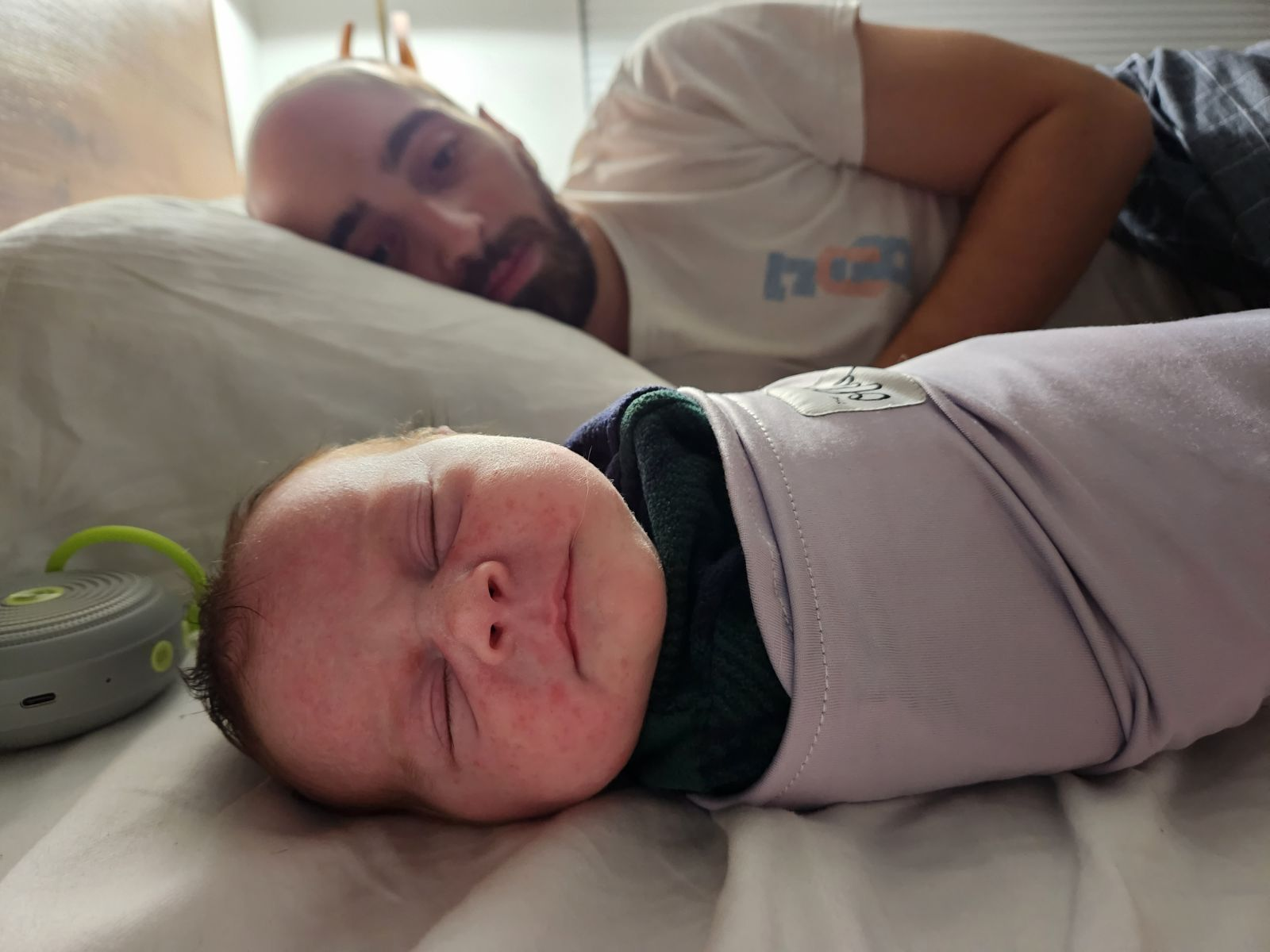
Lola's father is excellent at diaper changes and sleep swaddling. Here he is, and here she is, swaddled with a little white noise machine near her head. My daughter is doing well, healing, nursing, walking, creating new routines. She plans outings, so we have been to a park and a garden where we saw many ducks, a flock of geese that rose from a pond, circled it, and resettled, and a bald eagle in a treetop.

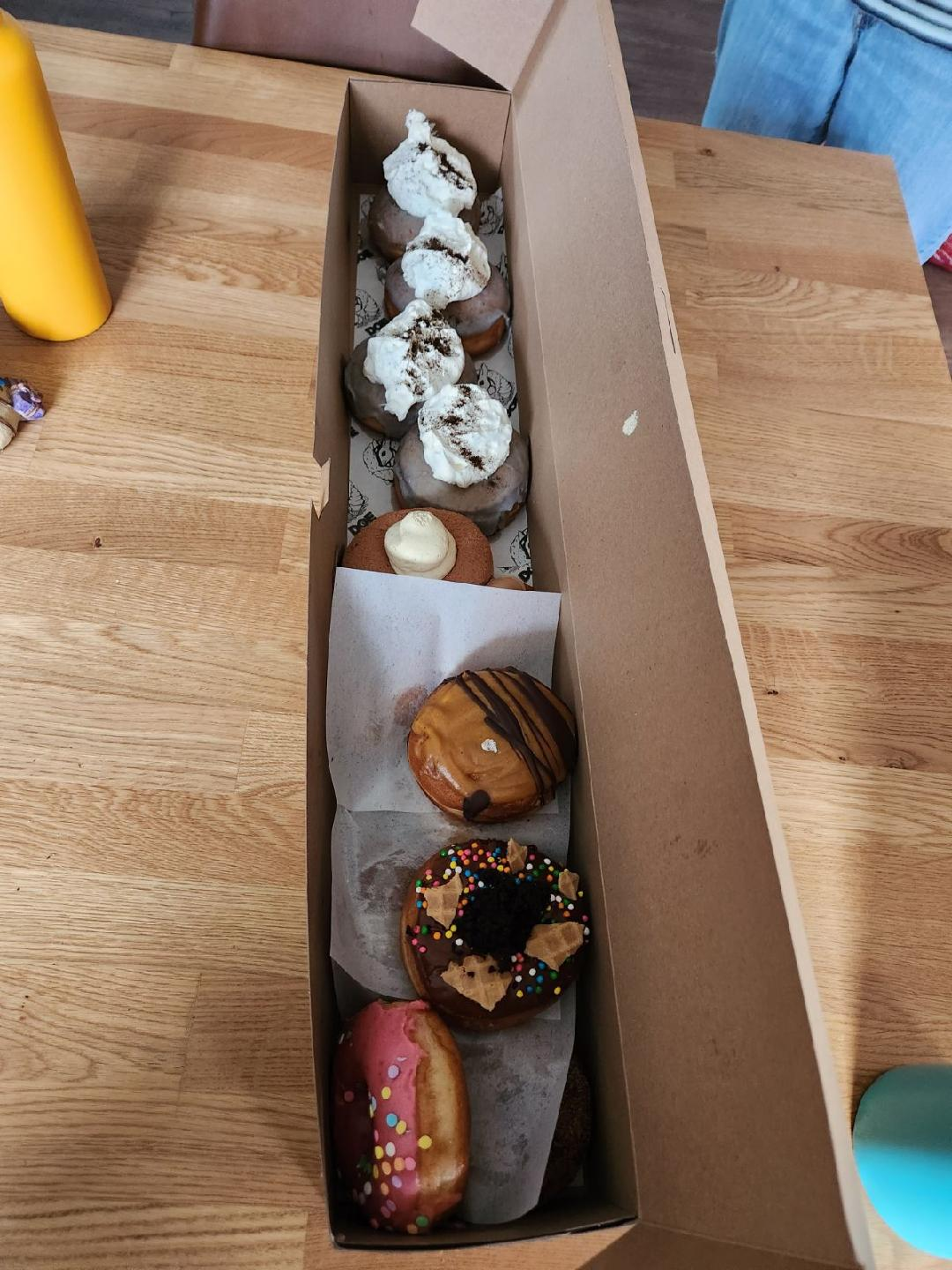
Another outing was to Doe Donuts, which I highly recommend if you go to Portland, a town well known for donuts as well as Powell's Books! We all loved the whipped-cream topped donuts called Portland Fog! Their logo has a sweet doe, but I don't have a picture of that. And while Doe Donuts doesn't love day-old donuts, I do. Another favorite was cranberry lime.

Thursday, July 20, 2023

Red Hibiscus, Fog, Sitcoms, Shock, Badassery

Dear blog readers, I haven't forgotten you--I just write my blog to you in my head while swimming, early in the morning. Twice now, I've gone swimming in the fog--once a drifty, blowy fog and today (was it today?) a stationary fog that soon disappeared. Since lap swimming is repetitive, I do lose track of days. It also becomes meditative. As the summer has progressed, that easy breathing thing has happened. I feel like I could swim forever. But this is sometimes followed by my nose having to remind itself not to breathe water, my body thinking it lives here now. 

The other meditative thing I did lately was walking the trail through two butterfly areas--the butterfly refuge, a wild native prairie with monarch-loving plants and mown paths, and a planted butterfly garden maintained behind the cancer center. The latter has a labyrinth, where I did a walking meditation.

But first a shocking thing happened: a man pushing a stroller with two children in it came up the path saying to them,"Remember when I said I would slap you to the ground? I was just joking, but those people believed me." He then veered off the path to take a shortcut over a grassy hill to some apartments. (I don't think he was joking.) Then another shocking thing: on the trail a couple was talking about panic, saying, "You can panic all you want if you keep saying you're right." And then, "They'll break into our homes and shoot us in our beds." What is going on? It was just a beautiful, peaceful day otherwise. It seems like America is scared and angry, and violent. On a Saturday, with kids.

But today is Thursday, or Thor's Day in the blog. I can conquer this with peace and poetry. And comedy. And sorrow. I have two poems in the current issue of Redactions, the Sitcom Issue, because my life is a sitcom (Mad About You) and a dark, quirky comedy (Everybody Loves Raymond if it was rebooted as a future White Lotus). To further mess things up, both of these began with biblical prompts, during Lent.

My husband had a birthday this week, and we celebrated by going to a poetry reading (he liked it!) and taking the poet and her husband out to dinner. The poet was Lynne Jensen Lampe--she came to our little public library from Columbia, Missouri--reading new poems, and poems from her new book, Talk Smack to a Hurricane. We have a robust reading series of local and regional poets, and, especially since our virtual programming during Covid, many far-flung poets, some, like Lynne, who still show up in person, and some who remain virtual. I'm delighted that Chicago poet Yvonne Zipter will come down in October. Really, it's a fantastic series that doesn't get much local media attention, but I am reading Year of Yes by Shonda Rhimes, thanks to my new pastor, and so may try to attempt some marketing badassery soon. Shonda makes me laugh out loud. Thank you, I needed that!

Thursday, January 26, 2023

Still Tidying, But Elsewhere

As the title says, I'm still tidying, but elsewhere these days. My sister and I have been tidying, organizing, labeling, and "staging" in preparation for my parents' move from a 100+ year-old farmhouse (that we grew up in) to a two-bedroom independent living apartment in a retirement community. It's a time of ongoing grief and overwhelming stress, and we haven't been able to engage our parents in "the life-changing magic of tidying up." But we have made headway on organizing, donating, and tossing my mom's clothes and shoes. My dad is another story. (He'll tell it!)

To calm down, my sister has left town (she's on a research leave!!), and I have been reading Dying of Politeness, a memoir by Geena Davis. I love Geena Davis! She is fun, funny, smart, a wonderful actress and a world class archer. Her mother had Alzheimer's, making this a Random Coinciday in the blog. I so connect with Geena Davis's shyness. I am so glad she feels more confidence and badassery now! And, wow, about the Geena Davis Institute on Gender in Media. She is making a difference in our world!

I have also been reading The XX Brain, by Lisa Mosconi, which is 1) not so calming 2) affecting my grocery shopping: more blueberries and (finally available!) salmon. It is disheartening to read, I think in the foreword by Maria Shriver, that Alzheimer's arrives in the brain 20-30 years before it presents. And yet!: it's never too late to increase exercise, start the Mediterranean diet, do crossword puzzles and other brain games, and advocate for oneself with doctors. Sigh...  Lisa Mosconi for women's health and Geena Davis for gender awareness, yay, thank you!!

Thursday, December 1, 2022

Day Without Art

Today is December 1, World AIDS Day, commemorated in the beginning as a Day Without Art, to acknowledge all the artists, of all kinds, that we lost in that pandemic, alas! So...no art today in the blog.

It's a day I pause to remember theatre artists Mitch Webb, actor, and Scott McPherson, actor and playwright, both lost to AIDS. We worked together in Chicago, and I also went to college with Mitch. These two, and so many others. It is terrible to recall. 

It's a day of turning the calendar page, and, in my case, on one calendar, two pages. Sigh... I have many calendars, some portable, some on doors or desks or walls. One is in a project bin beside my computer. I lose track of some of them.

It was 16 degrees this morning! But sunny. I went with Ken Kashian, a photographer, to Chenoa, to do a live radio broadcast with Kent Casson, for his show Route 24. Ken Kashian has created a new artist book, Fugue, and I have written the tiny poems for it. He took photos of the native plants and tombstones in the Weston Cemetery Prairie Nature Reserve. Not showing you any. It's a day without art.

Thursday, September 2, 2021

Big Year

It looks to be a "big year" for birders in our area! Yesterday, as September began its beautiful weather, I took a walk with a friend* through a good set of trails for birds. We saw a serious photographer getting some good shots and keeping us from getting lost! I've been happy with my summer of back yard cardinals, wrens, and goldfinches, awed by the occasional hawk, and involved in the various crow conversations...

And, of course, there were birds in the various books of poetry I read in August! Crows, sandhill cranes, and whooping cranes, as mentioned, but others, too!

*the same friend I saw this movie with, as I recall! (My recall is sort of haphazard, so maybe she told me about it...but I think we saw it together! It was a thing we did sometimes, back in the days of going to movie theatres. I know we saw It's Complicated together, because I remember laughing a lot. Wait, both these movies have Steve Martin in them. Maybe we only went to Steve Martin movies together. This blog entry started out completely differently. Hmm, it has turned into a Random Coinciday in the blog!)

Thursday, August 26, 2021

Indigo

Wasn't I reading this last year at this time? Re-reads are OK for the Sealey Challenge! Checking my blog, I realize I was reading Indigo, by Ellen Bass (Copper Canyon, 2020) last April, during lockdown. See the beautiful fish in this tattoo? I'm also reading Russell Banks's Success Stories (Harper & Row, 1986), with the fish cover, and just finished "The Fish," a sort of fable. Once again, everything connects.

Oh, yes, I remember "smashing / the garlic with the flat of steel" from "Sous-Chef," the opening poem, and I'm back to smashing garlic this way myself, having broken two garlic presses over the past year. "You say how much cinnamon / to spice the stew." When I walked into the kitchen this morning, I thought I smelled cinnamon...

Yes, here are the orange and white high heels she shares with her mother. The chickens named Marilyn & Estelle. The bone china. "Another spoonful of crème brûlée, / sweet burnt crust cracking" (which reminds me of a Jeopardy answer-question). And the contemplation of a good and chosen death in the poem "Enough," which ends with "a fish that couldn't wait to be caught."

"Can a tree be lonely?" is a question in a poem about the old dog Zeke. I'm reading indoors this time, in air conditioning, during a heat advisory in the delayed or prolonged dog days of August. In the next poem, it's December. Life goes as quickly as that. 

The poems of the mother, the mother dying, the mother in the vigor of her life before that. I was meant to be re-reading these poems today in a waiting room, but my mother had to cancel her appointment, not feeling well. 

In "Wilderness," a love poem, the lines "Tell them a story, / you are doing to die" remind me of texts in Deathbed Sext, by Christopher Salerno, earlier this month. "Because What We Do Does Not Die" is a wonderful poem where the mother defends and supports her daughter, getting rid of a bad guy forever.

Ah, here is old Zeke again, in "Ode to Zeke." "I'll fry you a fish." And here is the heroic Lynne, who revives a lizard who was drowning in the swimming pool, in "Kiss," which is the kiss of life.

And I do so love the poem "Indigo," that starts with a tattooed man "pushing one of those jogging strollers / with shock absorbers so the baby can keep sleeping" and ends absorbing the shock of death in the strong, clear voice of a grown-up daughter who is wide awake.


Thursday, August 12, 2021

Deathbed Sext

In the title poem of Deathbed Sext, by Christopher Salerno (Two Sylvias Press, 2020), I learn that "You can pay to receive / five texts a day that say, Don't forget / you are going to die." These days, I can't forget! And these lines got me in "The Byronic Method": "When I sexted you a snorkel you sexted me a squid." "When I sexted you / a telescope you sexted me the moon." 

I'm loving the variety of poems/books I'm reading for the Sealey Challenge, and the random coincidii. Last night thunder woke me up, and today it kept rolling through like tanks. In Deathbed Sext, I find battlefields and this: "To...be woken by thunder in the middle of the night..." (means "You'll Never Get Back To Sleep Now").

The book starts with a shocking hit-and-run accident, the speaker of "Headfirst," a boy on his bike hit by a car that drives on. Made me think of Raymond Carver's story "A Small, Good Thing" as adapted and interpreted in Robert Altman's film Short Cuts. But here the boy lives and presumably grows up to be a poet. 

There is serious stuff but also humor and wordplay, as in "Dickinsonian Pics": "I heard a phone buzz when I died. / Your sext lit up the larger darkness." And I love the "waltz[ing] away from what // once was monstrously male..." that threads in and out of these poems, summed up for me in the line: "I was sent to fetch a crescent wrench that wasn't even there." The futility, the performativity.

And I love this closing stanza (equal time to hens, after the roosterishness above) from "At the Farmstand During the Solar Eclipse":

     Not even noon but the entire farm
     is going dark, and every last hen,
     from instinct, returning to the coop.

Book cover artist: Noela Kanecka (Isn't it wonderful?)


Thursday, August 5, 2021

In the months of my son's recovery

Today's book opens with Kate Daniels's wonderful song of herself, "Her Barbaric Yawp," referencing Walt Whitman's song of himself via epigraph: "I sound my barbaric yawp over the roofs of the world." It's celebration and lament, praise for the aging woman who misses her juice. Great, bold fun, terrific honesty. The honesty continues in the addict's story within In the Months of My Son's Recovery (Louisiana State University Press, 2019), though I should mention her disclaimer via A Note to Readers: "These poems are narrated by a character similar, but not identical, to myself, and represent other characters and situations that may be archetypal, emanating from many aspects of and perspectives on the current opioid epidemic." In the center of the poem titled "In the Midst of the Heroin Epidemic" is the crux of it all:

                                                           Addicts destroy
     themselves--that's just where we start. And why
     they might have wanted to, or if it was an accident
     is beside the point... The aftermath is what's at stake.

A partial narrative is told just in titles: "Detox," "Getting Clean," "Relapse," "Recovery." Poems about meetings, support groups. While it is "her" story, and his, her son's, uniquely their own, it is also like every other story of addiction I've ever heard. We know what happens. If only we could stop it! We can; we can't. From "The Brothers," this:

     Addiction is a family disease. It infects
     each member and distorts their stories. It lives
     to breech the boundaries of given texts,
     and to change old narratives and destroy
     plots you thought were set in stone.

This is a heartbreaking and heartbreakingly familiar story--the addict who steals from his own family to support his habit. The endless worry and stress. And then such a stunning tribute to "The Daughter-in-Law," who climbs through a window to get this man to rehab.

And there's more woe--breast cancer, divorce. What amazing strength and resilience, patience and liberation. To get to "Detachment." To get to "Yes."

Thursday, February 18, 2021

Meanwhile...

While I was grousing, wrapping up in blankets, feeling cranky and fatigued from the cold and Zoom, Japan had an earthquake (a delayed aftershock), a train derailed downtown, there was a bad fire at a complex housing students (12 apartments destroyed, the residents displaced), local firefighters had to battle that fire and fires related to the derailment in sub-zero wind-chills, Texas had a snowstorm (!), Portland had an ice storm, and now it's snowed in Nashville. Meanwhile, though Covid-19 rates are down, people are still suffering and dying from it. My little problems feel small indeed. Still, I forgive myself and give myself the needed days of just reading and resting. It helps me be better, I hope, when I interact with people again. Sigh....

One of the books I read on my couch was News of the World, by Paulette Jiles, a paperback I got from the ongoing library sale and which will go out in our Little Free Library once it's warm enough to go out there again. Tom Hanks is in the movie of this, and when I Googled it, it looked like I could see it on Netflix, but that was old news indeed. Or confusing news. Netflix streams it internationally but not here in the U.S., where it is again playing in some theatres, it appears. I will wait. But I am eager to see Helena Zengel, the young actor who plays the girl taken captive by the Kiowa, with whom she identifies, though her family of origin is German. I was drawn to her in the book.

The sun is shining today! It's up to 22 degrees! I felt warmer at work by keeping my hat on, and now I'm warmer at home by keeping it on still! My chalkboard poems have been shivery and blurry but there all month so far, and it's a short month, so I'll probably make it--a poem a day.

Monday, August 31, 2020

Sealey Challenge, Day 31

What a month, what a challenge, and what a joy: to read a book of poems a day in August. Here they are! A big thank you to poet Nicole Sealey, who dreamed up this challenge to make sure people made time to read poetry! I'm glad to have made the time, and it was fascinating to see the connections I felt to the poems and poets, and the connections between the poems in the books. 

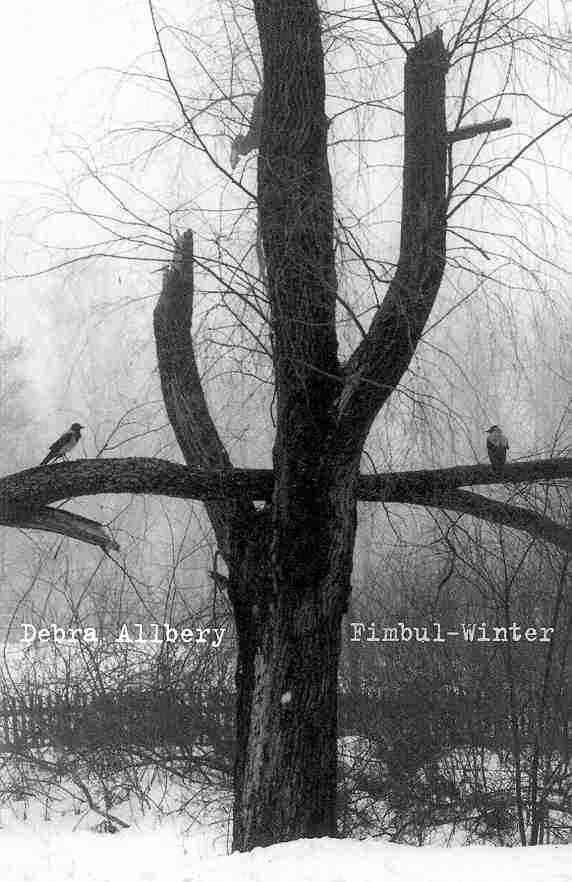
Today I met again fire, tornado, television, and elegy in Fimbul-Winter, by Debra Allbery (Four Way Books, 2020). Holy moly, do I know how to pick them or what? I put this one on the pile back in the super-hot days, thinking winter images might give me a little relief from the heat. But the weather changed, and it's gorgeous. And now I realized I've ended with Fimbul-Winter, aka Fimbulvetr of Norse mythology, "the harsh winter that precedes the end of the world and puts an end to all life on Earth." Just what we need.*

This was a cold book. It wasn't always winter in the book, but it always felt cold--and mysterious and haunted. "Chronic Town" describes "that icebound city" where:

     In the library, the homeless slept upright
     at long tables, gripping their open books."

Of course, I watched some short training videos at work today on the homeless in the library. I worry about them this winter, if libraries have to close again, or have severely limited hours due to Covid. A Fimbulvetr, indeed.

The post office is under siege but there are still letters in Allbery's poems! Letters to a lost love. "This morning / I drove twelve miles just to mail a letter." And "Sometimes I still address / envelopes to you, I even stamp them, / stand them empty, weightless on my desk." Well, that's a lonely image. It's in the poem "Constellation" (which is a letter, opening, "Dear C--"), where I learned more about Orion:

     I know that Orion means foot-turning wanderer.
     That Rigel, the brilliant star marking his left foot,
     is actually two stars revolving around each other.

I'm going to stand looking up at the sky tonight, for sure.

In "Firelands," I learned again about the mine fire, still burning, that wrecked an Ohio town and met up with two random coincidii: 1) I also have Ohio family connections and 2) I also propped up my window today with a stick of wood, similar to this:

                                                       In summer,
     propping up my bedroom window with a scrap
     of plywood, the heft and heavy rattle of warped glass.

My window is still propped open now, with crickets calling me out to see Rigel

In "After Vermeer," the husband is up on the roof clearing out the gutters in the rain, in a dream, just like my husband, in waking life. And while I read this afternoon, the neighbor girl came out again, wildly singing in the breeze. It's September tomorrow and September in the poem "The Wakeful Bird Sings Darkling," but it's still cold.

     The sun could never find its way
     to our windows; the walls were thick
     as a bunker's, stolid, stone and stone
     and stone.

A bunker is a good place to wait out the end of the world, right? This is the September of 9/11, and she's home in their stone cottage with a sick baby:

     That September morning's iris of sky just as fierce,
     stripped and raw, too close; I shielded the baby
     with my shadow. Then the quiet was tipped
     by the ratchet of a kingfisher plummeting
     from the power lines into the dark mirror
     of our pond.

This baby brings some welcome joy into her life and this book. "Where is our laugh?" he asks. "Where does it live inside us?" And so do "[t]umbleweeds...wild as untethered joy..." But this Fimbul-Winter feels cold throughout, even the fire moments, even the feverish moments, cleaving to its title and theme. I was astonished by the clarity, and a circling back, of this set of lines in Part 4, Death in the Woods, of "In the Pines":

                                          The point

     of the story is to keep her cold mystery,
     keep that circle drawn around her

     higher and higher, a glass wall, keep everyone
     from getting any closer.

*Also, I should maybe now watch Thor: Ragnorok, which is also about this, and to make it a Thor's Day on a Blue Monday, and, of course, a Poetry Someday and the recurring Random Coinciday in the blog. (Wait, does that movie poster say November 3?!** Aauughh!) Tomorrow I resume a previous project: chalkboard poems! The plan is a short poem a day on the green easel chalkboard beside my front stoop, poems posted at Facebook and Instagram, and I'll probably tell you about them sometimes here, too!

**This movie is already out--came out in 2017, like several of the books I read!--but November 3 is looming as the end of the world, alas. Please, please vote, America, and save us all.

Thursday, August 27, 2020

Dear Future

For the #SealeyChallenge today, Day 27, I read Dear Future, by Nina Corwin (Glass Lyre Press, 2017). What a great cover, right? It's by Bliksem Steen. I know Nina from my Chicago days, and we've worked together on readings at Woman Made Gallery. I've enjoyed her company and her poems for many years. What a fun and strikingly pertinent book this is, full of delightful titles, matching their provocative content, which pursues the promised theme of the future. Nina is also a psychotherapist, so you can bet these poems are wise, philosophical, and insightful.

Examples of the delightful titles: "Poem in Which I Go to the Movies* and See My Future in the Previews," "Poem With a Line From an Ad for Capital One," "What to Pack for the Apocalypse."

*And today two local movie theatres, maybe more, are talking about re-opening! Alas, as our Covid-19 rate is rising, and I expect mitigation measures soon....

I loved looking through "Darwin's Telescope" at lines like these:

     Pretty soon, belief becomes suspension bridge.

     Not long after, I take Underdog,with his little white U and blue cartoon cape, to be my psychic savior.

     ...

     I, too, have my hungers. The hunter-gatherer in me. The need to name on the table of my tongue. The need the need the need

From "What to Pack..." this scary couplet:

     When heads of state play chicken
     on a cliff, the speed of the hotrod is everybody's business.

From "In Due Time," a set of letters addressed, "Dear Future":

     Our steps are bedeviled
     with questions: What
     will we be

     when we grow up? Will we walk
     through a door or fall
     off the edge?

And this terribly pertinent couple of lines, standing out in my Covid reading: "...Spare no expense // on the latest vaccine."

I love those swinging light bulbs, Nina's big ideas, but the sepia gloom of our possible future scares me, moths coming for the light.

Thursday, August 13, 2020

American Gun

American Gun arrived in the mail today, so of course I sat down in the back yard and read it straight through, acknowledgements, writer bios, and all, for the Sealey Challenge, Day 13, while feeding nuts to a squirrel and listening to the breeze in the windchimes. It is a beautiful book on a horrific subject--gun violence--and truly a collaborative effort. American Gun is A Poem by 100 Chicagoans, edited by Chris Green (Big Shoulders Books, 2020). Big Shoulders Books is a publishing unit at DePaul University.

This book is free, and you can get it here, at Big Shoulders Books, in a variety of ways. "The editors ask that by taking a copy, you agree to support groups working on anti-violence efforts in Chicago." There's a list of organizations in the back, or you can choose your own. I belong to a local chapter of Moms Demand Action, part of a national organization working to reduce gun violence by raising awareness, teaching gun safety, and promoting sensible gun legislation. Chicago is having a hellish summer of gun violence, and I'll also use the book's list to target some extra help there. (Aauugh, "target.")

The group poem is a pantoum, a form with repeating lines that "mirror the semi-automatic firing of a weapon and also the seemingly endless cycle of shootings in Chicago," says editor Chris Green. "However," he goes on, 'the main title of this poem, American Gun, points to the gun epidemic as not simply a Chicago problem, but an American one." Indeed.

The poets writing together here, each composing two new lines while incorporating two lines given by another poet (as required by the pantoum form), include many I crossed paths with when I lived in Chicago: Tara Betts, cin salach, Jan Bottiglieri, Richard Jones, Valerie Wallace, Nina Corwin, Mike Puican, Mary Hawley, Barry Silesky, Virginia Bell, Patricia McMillen, Edward Hirsch, and I bet I missed some, as the poets' names are vertical beside the horizontal stanzas. Oh, and sometimes you must turn the book sideways to read the stanzas with long lines, a marvelous part of the book's design.

Here's a gorgeous stretch of heartbeat, heartbreaks, and horror that reveals the pantoum form, verses 46-49, written by these 4 poets in order, Marty McConnell, Joshua Carey, Edward Hirsch, and Christina Pugh.

     Each heart-beat timed, a ricochet,
     a holy echo. It's hard to remember our names,
     hard to breathe, take cover, bolt away
     from what's said of us through unfamiliar lips.

     A holy echo. It's hard to remember our names
     drowned by lead's loud whispering
     from what's said of us through unfamiliar lips.
     Run, hide, fight the false equivalents

     drowned by lead's loud whispering
     whispering a holy echo wholly unholy.
     Run, hide, fight the false equivalents
     to God, unholy god, who has withdrawn

     Whispering a holy echo wholly unholy,
     the device reverberates from human cochlea
     to God, unholy god, who has withdrawn
     his sinuous heavens far from America.

The book is printed on black and white pages, mostly black print on white pages, but also some white print on black pages, with red dot accents like drops of blood. Some words and phrases become images, echoes like gun reports or reverberations on facing pages. This, like the sideways pages, is the work of the book designer, Natalie Bontumasi, whose "creativity and expertise transformed American Gun into a visual poem," as praised by editor Chris Green.

Some of the wonderful poets in this book weren't even born when I left Chicago 20 years ago! They are the 16- and 17-year-old student poets whose words and experience are essential to American Gun. I loved reading everyone's bios as well as their stanzas. And this is definitely a contemporary pantoum, which admits variation from exact repetition (though most of the repetition is exact), allowing the poem to move forward (or sideways!) as needed.

Even if a single line sometimes stands out--"we could be alive to something better," written by Cecelia Pinto in her stanza and repeated by Larry Janowski in his (and I noticed those lines were often mirrored on the facing page by the designer!)--this is a beautiful sharing, truly a group effort. Sensible gun legislation is a group effort, too, and so is ending gun violence. Let's do it, together!


Thursday, August 6, 2020

The Obscure Hours

Today, Day 6 of the Sealey Challenge to read a poetry book a day August, I read The Obscure Hours, translations by Richard Jones (East of Eden Press, 2018). East of Eden is the book division of Poetry East, and these translations were published in various issues of Poetry East, of which Richard Jones is the editor. I was once his associate editor, as a graduate student at DePaul University. I remember how much he has always loved poetry in translation and ancient poets of simplicity and wisdom, and I found plenty of that here! With various partners, he has translated the work of Rilke, Basho, Petrarch, Apollinaire, Hitomaro, Issa, Machado, Neruda, and several others, nestled in beautiful art.

Of course, I read the first poem, "Lament," by Rainer Maria Rilke, aware of the connection to yesterday's lamentations and my tendency toward Covid reading, alas:

     Oh how everything seems far away
     and long past.

Yes, it does, but poetry makes it eternal. Rilke is paired with pictures of Rodin sculptures from the Rodin Museum in Paris. Rilke worked as Rodin's personal secretary!

(Another random coincidence here is "Archaic Torso of Apollo," the Rilke poem that ends, "You must change your life," as quoted in my Blogger profile.) And I have discovered, thanks to this book, that "I love the obscure hours of my existence / in which my intellect is absorbed in deep thought."

Here's a Basho haiku that made me laugh:

     I forgot my hat
     And now the cold rain's falling.
     Okay. Whatever.

And here's one that made me mourn:

     Leaning on her cane,
     My white-haired sister still weeps
     Beside her son's grave.

Here is the childlike joy of Isso:

     Snail, you're my hero.
     You will give all of your life
     to climb Mount Fuji.

And here's wisdom in simplicity from Ryokan:

     Falling cherry blossoms.
     The remaining cherry blossoms also become
     falling cherry blossoms.

And here's a short poem from Antonio Machado's Proverbs and Songs, that "gives the lie," as they say, to fake news:

     Your truth? No, the Truth---
     Come with me to look for it.
     Your truth's not even worth keeping.

And that makes it a Thor's Day (if I had a hammer...) as well as a Poetry Someday and, as it is so often, a Random Coinciday in the blog.

Thursday, July 30, 2020

Untelling

I loved Silver Sparrow and An American Marriage by Tayari Jones so much that I needed to read her other books, too, and fortunately interlibrary loan is again possible, so I got hold of The Untelling and Leaving Atlanta. The latter, set during the Atlanta child murders in 1979, is heartbreaking. Both books are continuing my anti-racist education, as I am learning about black life from black authors. In Leaving Atlanta, Tasha's father joins a search party for one of the missing children and is partnered with a white man. She overhears her father speaking privately with her mother at the dinner table. "Sometimes those decent white folks can understand that we can't forgive them." Yes. "Especially not at a time like this." We're in another terrible time now, still standing side by side, some of us, searching, and still caught in that terrible unforgiving place.

I was surprised to find "Tayari Jones" as a character in Leaving Atlanta. But it also made perfect sense, as the author was a child when the child murders were taking place. (Here's a Reader's Guide pdf about that.) I was surprised and delighted to find a character named Octavia, as I'd just been reading a lot of Octavia Butler. Coincidence?! While Octavia is the point-of-view character, she's worried about a missing boy, a friend in her class at school. Girls have giggled about a possible romantic connection there. That and the geography give us this beautiful sentence: "The sound of wind in the pecan trees was like girls giggling." Will I ever be where I can hear the wind in pecan trees?

In The Untelling, a young woman learns who she is through empathy, awareness, and suffering, and on the way to that she's not always "likable," a wonderful risk for an author to take, and she's otherwise meant to be a sympathetic character, who has survived a terrible loss. "I wanted to tell him that I knew how he felt, though I probably did not. How can you know what another person is going through when your own life is so different from his?" This is so real, so honest. "People had done this to me often enough, telling me that they knew how I felt because they had suffered this or that loss, felt some sort of pain." She's impatient with the gesture of empathy, that possibly surface connection, and decides it's probably best to say nothing: "...I could predict his response, his words, polite enough, thanking me for my empathy, my generosity of spirit. And I could imagine his thoughts, that no, I couldn't possibly empathize. Our situations were not the same at all." She's right, but is it also an excuse for not reaching out to comfort someone?

The book explores differences of class and circumstance among black characters, with differences of race in the background. But I understood that differences of race might prevent any attempt of mine to reach out in empathy to a black person, as I recognized in the words above something that had happened to me. I reached out to a black woman as a woman, and was firmly and not so politely rejected. No, being a woman was nothing like being a black woman. I got her message. But then we went through something hard together, bonded, she appreciated my support, and I feel connected to her forever. Yes, we experience life differently, for many reasons, among them the history of race relations in America, but I can accept that now, feeling the human bond with her. I can respect and honor our difference inside this deep human bond, whether she and I can ever express that to each other in words.

Thursday, July 16, 2020

Fever Year

Graphic novels are a great way to receive a lot of information. That is certainly the case with Fever Year: The Killer Flu of 1918, by Don Brown. This was intentional "covid reading," so I could gauge age appropriateness of this book for a possible future Browser Pack at the library. One family had requested books on Covid-19 for kids (I don't think there are any yet), but I knew we had this. It's more appropriate for a teen than a youngster, given the amount and darkness of the facts.

This book, published in 2019, right before the current pandemic, is dedicated "to the Centers for Disease Control and Prevention, an underappreciated American treasure."

Here are the "fun facts" and, of course, not-so-fun facts about the flu pandemic of 1918, which killed more people than combat did in the Great War, known eventually as World War I:

Word origin: flu/influenza. Italians thought it came from "celestial influence" and called it ex influential colesti, which got reduced to una influenza in common speech.

"Spanish flu": The 1918 flu pandemic appears to have begun in the United States and got to Europe via "doughboys" during the war. There it proliferated and returned, affecting soldiers, the Red Cross nurses who tended them, and many civilians. When it got to Spain, it got the nickname "the Spanish flu" because Spain felt free to report on the illness without revealing weaknesses related to military preparedness. Spain did not like being blamed for the pandemic. (We know of the similar misnomer attached to the current virus.) Also inaccurately, people blamed the flu, and everything else, on the Germans.

Famous survivors of the 1918 pandemic: Franklin Delano Roosevelt, Walt Disney (who got it at 16 and then went to France as an ambulance driver), President Woodrow Wilson (at a peace conference in 1919), Mahatma Gandhi, Katharine Anne Porter, who wrote Pale Horse, Pale Rider about the flu, which killed her fiance and split her life in two.

Animals: No one knows for sure where it started, but it might have been "a wild aquatic bird," whose droppings infected chickens and ducks, then people, or pigs, and then people. In the search for a vaccine, a ferret sneezed on a human and gave him the flu.

Wax: The flu virus can survive in a sliver of lung sealed in a block of paraffin. Alas!

Waves: The 1918 flu pandemic was not over in 1918. It had resurgences until 1922.

Numbers: About a third of the world's population got infected. At least 50 million people died, probably more. The figures are estimates, and, then as now, uncertainty rules.

Masks: People fought over masks in the past, as they do now. Schools and theatres were closed. Masks kept the disease in check in some areas, and in some places masks were the law, and people were arrested for not wearing them. Imperfect use of and knowledge about masks, though, meant infection and death rate remained high.

False cures: camphor & garlic necklaces, goose grease, salt up the nose, nightcaps (the kind you wear on your head), onions, alcohol and rest and mustard plasters, coal smoke mixed with sulfur or brown sugar, home brewed smelly "medicine." (We may recall similar false cures recently in the news.) So there you have it, including Ebenezer Scrooge in a nightcap (in an illustration by John Leech).

Thursday, July 9, 2020

Old Lady Sweaters

Up until recently, I had two old lady sweaters, both aqua, the color of pools in Florida, after the old ladies have moved there. Indeed, both had belonged to old ladies in Florida, ladies I loved. One belonged to my Grandma Sid, and I kept it as a souvenir of her life. It had big buttons (just a few), clean lines, and a large fold-down collar. I wore it till I wore it out, and then I said goodbye. The other one belonged to my mother-in-law, and I took this one to work to wear in the air conditioning. It's still there--I wore it today!--but the top button popped off, a yarn-covered button, and it sits in the bottom of my tote bag that reads, "I Like Big Books and I Cannot Lie" until that possible Someday when I sew it back on. But first, I need to mend a ribbon (again) on one of my fabric masks.

I like big books, and I cannot lie. So I have to confess that this image is not my actual book bag, but a similar one. (And the colors remind me of Dunkin' Donuts.) I couldn't find an image of my actual book bag, which came from a library convention exhibits hall. And I have to tell you that as soon as I dedicated my summer to black authors, I realized I had been neglecting Richard Russo, an old white man. I've loved him since Straight Man (hilarious) and Nobody's Fool, and he's written lots of books since then that I failed to read. So now I am reading Chances Are... which is about old white men, but also when they were young. "Three goddamn old men," as it says on page 30.

It's also "an astute portrait of a thirty-year marriage, in all its promise and pain," according to a blurb on the book jacket. That, and my recent neglect of old white men in general, made me pick it up, soon after reading An American Marriage, a wonderful book by Tayari Jones. Everybody said it was wonderful, it was checked out all the time when it was new to the library, and we had two copies available, right after I finished Silver Sparrow, another wonderful book, about sisters, by Tayari Jones, so I snatched up and loved it all the way through.

So I am still reading black authors this summer, but, for a moment, this old white lady is reading an old white man. In the back yard on another hot day. As soon as I step away from this computer, in this cool lower-level home office, not wearing an old lady sweater.

UPDATE (weather and otherwise), next morning: truly cool now after a truly loud thunderstorm last night! Chances Are... is definitely not about "a thirty-year marriage, in all its promise and pain." Turns out that blurb is about That Old Cape Magic, info obscured by the necessary library item-number label! So, after Martha's Vineyard, I might have to head to Cape Cod.

Saturday, June 6, 2020

Wearing Orange


What a week. What a hard time for our country and our world. I am grateful for the peaceful protests in solidarity happening all over. I am sorrowful about the ongoing grief arising from COVID-19, police brutality, racism, hate crimes, economic inequality, global warming, pollution, and violence. Oh, my god, the list of sorrows goes on and on in my mind.

As June came up, I thought I’d write a tiny poem a day on an easel/chalkboard we had in the basement from when the kids were young, keep it out by the front stoop, take a picture each day and post it on Instagram for family and Facebook for friends, and bring a tiny bit of cheer or beauty or love to people daily, from my own skill set, when I feel helpless sometimes, or on hold, and don’t know what to do to help. But June 1 became a National Day of Mourning, so I started with that. Tuesday became our Blackout Tuesday, but I had put out my tiny-as-a-postage-stamp poem for the mail carrier already, so I just kept going.

Now I am quietly protesting gun violence in America on Wear Orange weekend, June 5-6, an ongoing virtual event. We are decorating our front doors with orange; mine is sprinkled with orange construction paper hearts, my chalkboard poems, and some tiny shiny bursting boxes with orange pipe cleaners. Official Wear Orange Day was Friday, June 5. June 5 is also Breonna Taylor’s birthday. She was killed by guns in a terrible police mistake. But Wear Orange Day was created by friends of Hadiya Pendleton, dead at 15 by gun violence, back in 2013. My poem for that is hard, quick, and blunt. You understand why. 

Today I Wear Orange

to honor the dead girl
killed by a gun. Orange
like a hunting vest,
meant to say:
I’m not prey.

Hadiya had just been in the parade for President Obama’s second inauguration and was dead a week later.

I’m wearing my orange Moms Demand Action volunteer shirt today. Yesterday I wore my coral orange work shirt to plant salmon orange geraniums in the library planters, a marvelous coincidence. And I got to wear a bright yellow safety vest trimmed in bright orange to weed along the street. My shoelaces are melon orange.

I don’t like to jump on any bandwagons, but I do wish to stand in solidarity with all our nonviolent protestors today. At a distance, masked, I attended our local NAACP/Not In My Town rally to see, feel, and be part of the local support. I came late and left early, not wanting to mingle with any crowds. Couldn’t hear or see the presenters, but felt the solidarity. My peripheral vision made me turn at the right time to see potential danger, a young white man wearing a bandana on his forehead riding a motorcycle on Front Street. My gut said, Trouble. Later, he drove through the crowd and injured people; he’s been arrested. I listen to my gut now, having ignored it sometimes in the past. After seeing him, I scanned the crowd, as well. I was looking at the young white guys, I have to confess. There’s my current bias and tendency to profile. I apologize for the past, the present, and the future. I’ll do what I can, which doesn’t seem like much, but I do vote and help get out the vote, via a tiny elected office.

And my tiny poems will continue, at least through June. If I can remember what day it is. And who I am.

UPDATE: I stand corrected! (And that surely reminds me who I am!) When I walked down to a nearby park at noon, to join other Moms in orange, all of us holding up honk-in-support signs, you know who was among the honkers? Yep, young white men! Even a youngish white man in a bandana on a motorcyle! (He was wearing his bandana as a mask.) Supporters were men, women, and humans of all ages, white, black, people of color, a surprising number of them masked while driving. There's a whole array of honking styles, let me tell you. Also waving styles. We saw thumbs up and fists up. We were all wearing masks, so we tried to send smiles with our eyes, thumbs up back, and grateful nods. A beautiful day in the neighborhood.

Thursday, April 23, 2020

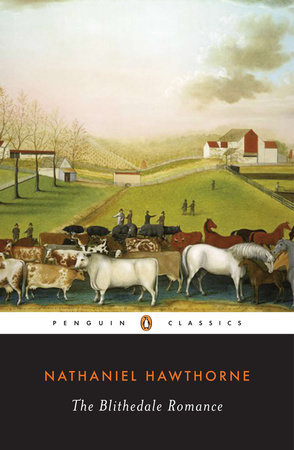
Blithedale Postponement


As I mentioned in the context of my loopy reading, The Blithedale Romance, by Nathaniel Hawthorne was up next, after Little Women (fiction) and American Bloomsbury (nonfiction) and the not-quite coincidence of all that genius in Concord, Massachusetts in the 1800s. (Ralph Waldo Emerson brought a bunch of smart people together.) It’s always good to read (or re-read) the right book at the right time. As I started re-reading The Blithedale Romance in mid-April, shortly after some unwelcome mid-April snow, I encountered an unwelcome mid-April snowstorm in fiction as Miles Coverdale travels to Blithedale to join an idealistic, intentional, back-to-the-land community, based on the actual Brook Farm that Hawthorne himself had visited for a time with high hopes. 

Then Coverdale gets laid up for two weeks with a rhinovirus! (common cold) in near isolation, tended by main characters Hollingsworth (driven by a single idea) and Zenobia (a beautiful woman and feminist). “Zenobia” is her writer/public figure name; she has a real name in the fiction and is probably based on feminist Margaret Fuller, who is named in the fiction, as if to separate the two, perhaps a courtesy.

Here are some more coincidences that surprised me:

--One of the entertainments in their little set-apart community is “tableaux vivants,” or dressing up as works of art. You may be aware that the Getty Museum challenge, etc. has inspired a lot of that in our current shelter-in-place situations.

--It shouldn’t have surprised me, as some summaries call Hollingsworth a misogynist, but he really is, and Coverdale, the narrator, calls him out on it, saying, “Hollingsworth had boldly uttered what he, and millions of despots like him, really felt.” Which was, basically, that woman is only a helpmeet at man’s side and must support him fully in his endeavors, blah, blah, blah. I guess the main surprise was Hawthorne outing “millions of despots.”

--Zenobia, complicatedly pissed off by this, retorts, “Let man be but manly and god-like, and woman is only too ready to become to him what you say!” Meaning, of course, that man isn’t.

--Earlier, Zenobia has said, in the context of supporting women’s rights, “Thus far, no woman in the world has ever once spoken out her whole heart and her whole mind.” It reminded me of Muriel Rukeyser, who said in a poem, “What would happen if one woman told the truth about her life? / The world would split open”

--Hawthorne sounds like a closet feminist himself, speaking through the character closest to himself in life, Coverdale, defending a broken-hearted woman:

It was nonsense, and a miserable wrong,—the result, like so many others, of masculine egotism,—that the success or failure of women’s existence should be made to depend wholly on the affections, and on one species of affection, while man has such a multitude of other chances, that this seems but an incident. For its own sake, if it will do no more, the world should throw open all its avenues to the passport of a woman’s bleeding heart.

Now, Coverdale sounds like a pretty feeling guy there above, but Arlin Turner in the introduction sees him as rather cold, aloof from fellow humans, and almost the worst villain of the piece, while I saw him as more the observer, as a writer necessarily is—Coverdale is a poet. Sigh… 

But, plot-wise, he had the power, probably, to act, and did not, and that’s what counts, alas. Even if you can’t achieve a utopia on earth, you’ve got to act in human sympathy where you can. I guess I forgave him for being human, flawed, imperfect, and a poet…

And I do think he’s right in opposing Hollingsworth, who cares not a fig for the utopian community, but only for his own one central idea, pushed relentlessly upon the innocent and unsuspecting, respecting only his will, not theirs. Coverdale thinks we are meant to tend to our own lives as best we can and “insensibly influence other hearts and other lives to the same blessed end,” not force our “philanthropy” on others or be subsumed by one overarching theory or dream.

Looping back, I should mention that the cold snap in Blithedale caused the residents to postpone their May Day celebration until later, when the weather would be nicer. Likewise, our shelter in place has been extended, postponing many things, but rightly so, as our governor, listening to the advice of experts, is thinking of the general good of all, not pressing his personal will upon us. (And that makes it a Thor's Day in the blog!)

Thursday, March 19, 2020

Hunker at Home


Relatives and friends of mine live in areas with official “shelter in place” status, so I am worried about them—and about us all!—and respectful of their strictures. Here in central Illinois, it is more of a “hunker at home” situation, for now, though the first local case of Covid-19 was announced this afternoon, so it is among us. Governor J.B. Pritzker just held a press conference to update everyone, and said he is considering the “shelter in place” option every day. 

I was so impressed with him and with Dr. Ngoke Ezike, Director of the Illinois Department of Health, for their earnest concern, their sharing of info, and their willingness to answer questions from reporters—in a virtual format. The only disconcerting part was watching what looked like more than ten people then exit the room, much closer than 3-6 feet apart, none of them in gloves, all touching the same door/door handle. Sigh….

For now, I am working at home on various things—writing and/or library related—and alternating these tasks with household tasks and reading, all to keep the body moving and the worry away. But Worry is not so good at “social distancing.” It sometimes gets in my face and my brain and my chest, a little pinch there when I try to sleep at night, so I get up and read myself back to sleep. It’s hard to stay focused, I lose track of the time and what day it is, and I feel so cold in the house—which always happens at this time of year, the transition to spring, before it truly warms up.

My local friends and my online friends are stressed, anxious, scared, worried about jobs as well as health, worried about kids and parents. We are all going through this together, and I see so much kindness. Sadly, I see judgmental comments, too, and hear about mean comments. Goodness, we need to be patient with each other as well as the situation! And I also appreciate the humor—dark humor, gentle humor, wacky humor. And the wine. I didn’t hoard it. So it will run out. Maybe before I do!

But I did go out walking, on the last sunny day we had. It was Election Day, and I voted. It was St. Patrick’s Day, and I didn’t do anything particularly Irish. I did wear green gloves at the polling place. I walked the local rails-to-trails hiking/biking path, and was pleased to see so many people out. We kept our distance, but most of us greeted each other with a nod or a smile. (Except that guy coughing in the shelter. We all stayed away from him. A young man, fiddling with his phone.) And I walked the labyrinth behind the cancer center, no one else there. I let my mind go where it would, and it went everywhere, and back. Just like the labyrinth.

Hang in there, everybody! Hunker at home. My heart goes out to you!