Monday, August 31, 2020

Sealey Challenge, Day 31

What a month, what a challenge, and what a joy: to read a book of poems a day in August. Here they are! A big thank you to poet Nicole Sealey, who dreamed up this challenge to make sure people made time to read poetry! I'm glad to have made the time, and it was fascinating to see the connections I felt to the poems and poets, and the connections between the poems in the books. 

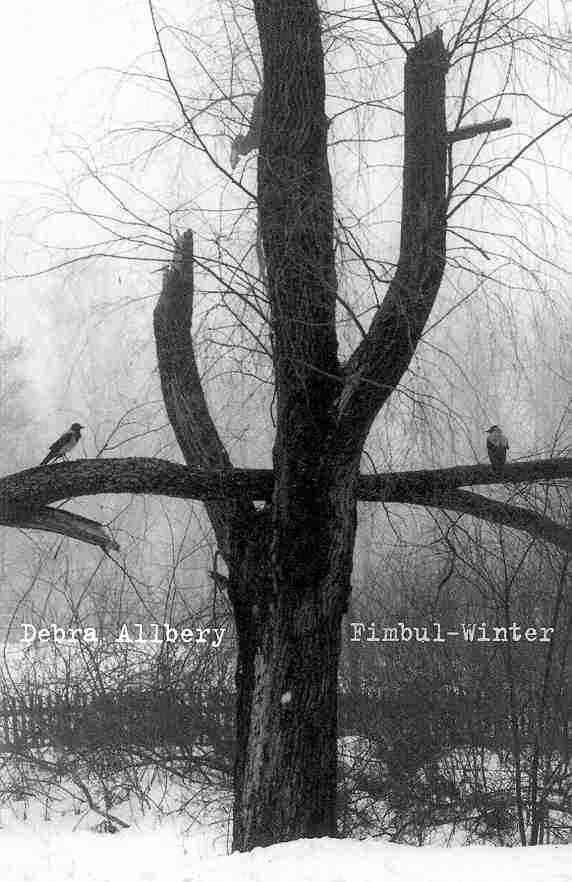
Today I met again fire, tornado, television, and elegy in Fimbul-Winter, by Debra Allbery (Four Way Books, 2020). Holy moly, do I know how to pick them or what? I put this one on the pile back in the super-hot days, thinking winter images might give me a little relief from the heat. But the weather changed, and it's gorgeous. And now I realized I've ended with Fimbul-Winter, aka Fimbulvetr of Norse mythology, "the harsh winter that precedes the end of the world and puts an end to all life on Earth." Just what we need.*

This was a cold book. It wasn't always winter in the book, but it always felt cold--and mysterious and haunted. "Chronic Town" describes "that icebound city" where:

     In the library, the homeless slept upright
     at long tables, gripping their open books."

Of course, I watched some short training videos at work today on the homeless in the library. I worry about them this winter, if libraries have to close again, or have severely limited hours due to Covid. A Fimbulvetr, indeed.

The post office is under siege but there are still letters in Allbery's poems! Letters to a lost love. "This morning / I drove twelve miles just to mail a letter." And "Sometimes I still address / envelopes to you, I even stamp them, / stand them empty, weightless on my desk." Well, that's a lonely image. It's in the poem "Constellation" (which is a letter, opening, "Dear C--"), where I learned more about Orion:

     I know that Orion means foot-turning wanderer.
     That Rigel, the brilliant star marking his left foot,
     is actually two stars revolving around each other.

I'm going to stand looking up at the sky tonight, for sure.

In "Firelands," I learned again about the mine fire, still burning, that wrecked an Ohio town and met up with two random coincidii: 1) I also have Ohio family connections and 2) I also propped up my window today with a stick of wood, similar to this:

                                                       In summer,
     propping up my bedroom window with a scrap
     of plywood, the heft and heavy rattle of warped glass.

My window is still propped open now, with crickets calling me out to see Rigel

In "After Vermeer," the husband is up on the roof clearing out the gutters in the rain, in a dream, just like my husband, in waking life. And while I read this afternoon, the neighbor girl came out again, wildly singing in the breeze. It's September tomorrow and September in the poem "The Wakeful Bird Sings Darkling," but it's still cold.

     The sun could never find its way
     to our windows; the walls were thick
     as a bunker's, stolid, stone and stone
     and stone.

A bunker is a good place to wait out the end of the world, right? This is the September of 9/11, and she's home in their stone cottage with a sick baby:

     That September morning's iris of sky just as fierce,
     stripped and raw, too close; I shielded the baby
     with my shadow. Then the quiet was tipped
     by the ratchet of a kingfisher plummeting
     from the power lines into the dark mirror
     of our pond.

This baby brings some welcome joy into her life and this book. "Where is our laugh?" he asks. "Where does it live inside us?" And so do "[t]umbleweeds...wild as untethered joy..." But this Fimbul-Winter feels cold throughout, even the fire moments, even the feverish moments, cleaving to its title and theme. I was astonished by the clarity, and a circling back, of this set of lines in Part 4, Death in the Woods, of "In the Pines":

                                          The point

     of the story is to keep her cold mystery,
     keep that circle drawn around her

     higher and higher, a glass wall, keep everyone
     from getting any closer.

*Also, I should maybe now watch Thor: Ragnorok, which is also about this, and to make it a Thor's Day on a Blue Monday, and, of course, a Poetry Someday and the recurring Random Coinciday in the blog. (Wait, does that movie poster say November 3?!** Aauughh!) Tomorrow I resume a previous project: chalkboard poems! The plan is a short poem a day on the green easel chalkboard beside my front stoop, poems posted at Facebook and Instagram, and I'll probably tell you about them sometimes here, too!

**This movie is already out--came out in 2017, like several of the books I read!--but November 3 is looming as the end of the world, alas. Please, please vote, America, and save us all.

Sunday, August 30, 2020

Turn Left Before Morning

Whether on purpose or by accident, I keep reading the right book on the right day, adding to the pile up of random coincidii... Yesterday, I mentioned resting after gardening, with poetry, and today, in Zoom Church, the theme was rest, which I did not do. Instead, I brought up more boxes from the basement, recycled and rearranged, and took (much less) back downstairs in a (much more) waterproof way with (a little bit) more organization. Then I read Turn Left Before Morning, by April Salzano (Rattle, 2016), and wrote in my (new, as in, found in one of the boxes) little notebook, "OMG, this woman can never rest!"

She's the mother of two sons, and her poems show her valiant efforts to be a good mom to both, in a life overtaken by the challenges of her son who has autism. She must be exhausted. She drops us into her life right away, with "Maybe God," the first poem, which begins, "Maybe God is in the broom closet / at my autistic son's elementary school..." We see him in various grades, in diapers, naked running down the hall, with various frustrations and quiet joys. And her joy is there, too, in rare and brief glowing moments. There is so much straight talk in this, grief and annoyance, ambivalence, and love, love, love. 

"I used to love dogs," she says in the poem "Clarabel." "Before kids and autism and bankruptcy and marriage and remarriage," and these troubles go on, until, "I lost something, some fraction of the capacity to love." To love dogs, that is, "to love just one more thing that needed loving." I get it, and it's OK. She's got her hands full, and there are plenty of dog lovers out there, and love to go around.

This poem hit the spot for its title, "Late Summer Sun," and opening reference, I think, to Stevie Smith's "Not Waving but Drowning." Salzano begins:

     I watch the trees outside the special school,
     not waving but standing
     still as any August. I am waiting
     for the wide doors to slide open,
     wheelchairs to be ushered forth
     like carnival rides. I hold tight
     to this latest pearl in a string 
     of promises, little hopes so easy to lose.

Here, in this back-to-school time for many, Salzano has already tried many schools. And I see in her blog, that "the new normal" of Covid is a way of life--the isolation, missing the (old) normal, expected things--that she is already used to.

I was struck by the turn that happens in "And on the Other Hand," the turn toward joy, and how this also matches what Lucia Perillo says about how a poem takes a turn. To quote Perillo again for a moment:

                                                    ...a poem, the tradition of which
     pretty much demands that the reader be told off the bat
     what a muckheap the world is. But then comes the swerve
     where the poet flipflops or digresses
     to come up with something that the muckheap
     will surprise you with.

And, as Salzano turns it, 

     Random fits of so much
     joy your heart tears
     and becomes two.

And then she turns it again, in the nightmarish, "Last Night I Ran Over My Autistic Son," so real I didn't know it was a nightmare. (Also because I know of a poet to whom this happened.) But this is where she "turned left before / morning," thank God. 

And the struggles and heartbreaks and goofy moments and giggling and love were able to go on.


Saturday, August 29, 2020

Oldest Map with the Name America


Today I rose early, before dawn. Once it was light, I gardened--watering, weeding, clipping, collecting cosmos seeds in an envelope--because it was finally cool enough, breezy enough. Then I rested, and read The Oldest Map with the Name America; New and Selected Poems by Lucia Perillo (Random House, 1999). I first started reading her poems in the 1990s, when she lived part of the year in Washington state and part in Southern Illinois, where she taught. This book culls poems from Dangerous Life (1989) and The Body Mutinies (1996), giving many, many new poems in Part 3. The oldest map of the world that names America is a woodcut wall map in 12 panels by Martin Waldseemuller from 1507, where, as Perillo puts it, "the world approximates that shape we call a heart."


I've been surprised by the coincidences in what I've read this month--a few being the recurrence of mosh pits, kimonos, television shows, among them, Star Trek, fire--and how I've been choosing books with America in the title or in the cover image. It's as if I want America to be better, to be saved. "Sometimes I feel history slipping from my body / like a guilty bone," says Perillo, and sometimes I feel that, too.

But let me give you fragments again, the random coincidii, and the glorious search for beauty in "The Revelation" and other poems: "you will find that beauty, a cataclysmic / beauty rising off the face of the burning landscape..." Fire haunts me again as a reader here, and in "La Vie en Rose," with Edith Piaf singing in the background in the car as her family flees a fire on the Jersey Turnpike. And in the beautiful "Ghost Shirt," Perillo juxtaposes a visit to the Museum of Natural History in New York City with the LA Riots in reaction to the acquittal of the officers who beat up Rodney King, and New York's response. Alas, history is still slipping from the body of America like a guilty bone. The "ghost shirt" hangs there as a warning in the museum, and, in history, for Indian warriors who need to take up the fight:

     A quote on the wall from the Paiute messiah
     said Indians who don't believe in the ghost dance

     will grow little, just about a foot high,
     and stay that way. Then some of those
     will be turned into wood and burned in fire
--

But at the end of the poem, after a fearful subway ride, she makes it safely home. "And the only fires were the tiny flames / of people holding candles, outside the public library." Thanks for that vigil, and that location! But I'm ahead of myself.

Perillo was a park ranger as well as a poet. She'd go up into the mountains to be alone and to listen:

     One reason I went up there was because at sundown
     when the wind climbed the back of the mountains
     along with the spreading violet light,
     you could hear the distinct murmuring that the Indians said
     were the collective voices of the dead.

I've heard that, too, in the wind of my own back yard. And speaking of mountains, another connection--to the purple mountains of the song but also to yesterday's Breathing Between the Lines, though, as Perillo notes, "when you get there, the mountains are never purple."

And in "Palimpsest" (a word I have to look up every single time*), I find again "those seven thousand plastic ducks / shucked loose when their cargo ship broke up at sea," that I'd read about in the news, but forgotten for a while. And "This I commit to memory forever: the command / I closed my eyes and forced myself to swallow like a hook" so she wouldn't forget certain wonderful things. I've done that! But I kept my eyes open that beautiful, breezy summer day--a day like today!--in the yard of my family home with my dog, and I have never forgotten that moment, that day, that dog, Dulcie!

*a piece of writing or art where the original has been erased or obscured by what came after; layers, as of history or nature working in this same way to cover but also possibly reveal what came before....

I love that she likes Edward Hopper paintings, and has a poem about them (so do I!), specifically "the women in Hopper's paintings," and how they are in natural poses, not poses at all like odalisques looking back over their shoulders, just natural women, really "all share the body of his wife, Jo, whom he drew / often with a crumbly rust-colored crayon / called sanguine, I've learned: French for blood."

Oh, I could go on and on with what I love, but I'll stop here, quoting a little bit from "The Sportsmen's Guide," a poem in honor of the birth of her nephew:

                                             ...Someday
     you could even write a poem, the tradition of which
     pretty much demands that the reader be told off the bat
     what a muckheap the world is. But then comes the swerve
     where the poet flipflops or digresses
     to come up with something that the muckheap
     will surprise you with.

I hope so. We need some good surprises. Soon. 

Friday, August 28, 2020

Breathing Between the Lines

It's almost September, and I've almost filled up the little notebook I'm using to take notes on these 31+ books I'm reading in August for the Sealey Challenge. Today it was Breathing Between the Lines, by Demetria Martinez (University of Arizona Press, 1997). This was a fascinating book of love poems, political poems, bilingual poems, poems immersed in language itself, with an essay at the end (linking it to the Poetry East: Origins anthology of poems with essays, and making it another Random Coinciday in the blog!) The essay is about process, yes, but also about the U.S. government taking her to court for her poem, "Nativity, for Two Salvadoran Women," and for smuggling two pregnant women across the border with a Lutheran minister as part of a Sanctuary movement. She and the minister were acquitted, but it was a lengthy and grueling process. It stopped her writing, before it led to a novel, and poetry came back later still.

As one of her poems is called "Fragmentos/Fragments," I will also give you some fragments that stuck out for me for various reasons.

From "Milagros": "the time has come to storm heaven." This meant what it meant in its own context ("after a painting by Francisco LeFebre") and time, but it seems so timely now!

I love how the title, "Before You," sets up the first line of this poem: "My poems had no you."

In "Everywoman," probably because of the food and because I was once in a play called The Clean House," these lines stuck out: "All I want / is a clean house // Salsa on Muenster cheese / Pan dulce."

Today, we need rain, it's hot, the air is heavy, so I reinterpret "History" for its present resonance: "We prayed for rain / and the rain came." I hope it does, overnight!

In "We Talk About Spanish," a poem about language and love: "I crossed over to him / Fearless as a spider," so I have to tell you I found a spider on this book, and it crossed over to me!

In "Translation from the Vietnamese," she "hold[s] a poem up to the light

     until it can be heard
     above the detonations

     in the crumpled silk of the jungle
     a six-toned wood flute
     the sound of one hand writing
     down the worlds that survived

In the fragments poem, she examines the difficulties of language, how it changes us:

     In moments of grace,
     poetry or prayer,
     English uses me.

     But most of the time, I use it.
     I do not always like what I
     have become in this tongue.

Oh, I have to note the irony of these lines right now, from "Wanted": "American your face is on wanted posters in post offices." Or should be. "Remember remember who you are America / Purple mountain majesty above fruited plains / worked by mejicanos."

And as the summer cicadas sing in my own back yard, I love this unique image: "cicadas hum like / gourds on ankles of pueblo dancers." What a month I'm having, learning so much through poetry!


Thursday, August 27, 2020

Dear Future

For the #SealeyChallenge today, Day 27, I read Dear Future, by Nina Corwin (Glass Lyre Press, 2017). What a great cover, right? It's by Bliksem Steen. I know Nina from my Chicago days, and we've worked together on readings at Woman Made Gallery. I've enjoyed her company and her poems for many years. What a fun and strikingly pertinent book this is, full of delightful titles, matching their provocative content, which pursues the promised theme of the future. Nina is also a psychotherapist, so you can bet these poems are wise, philosophical, and insightful.

Examples of the delightful titles: "Poem in Which I Go to the Movies* and See My Future in the Previews," "Poem With a Line From an Ad for Capital One," "What to Pack for the Apocalypse."

*And today two local movie theatres, maybe more, are talking about re-opening! Alas, as our Covid-19 rate is rising, and I expect mitigation measures soon....

I loved looking through "Darwin's Telescope" at lines like these:

     Pretty soon, belief becomes suspension bridge.

     Not long after, I take Underdog,with his little white U and blue cartoon cape, to be my psychic savior.

     ...

     I, too, have my hungers. The hunter-gatherer in me. The need to name on the table of my tongue. The need the need the need

From "What to Pack..." this scary couplet:

     When heads of state play chicken
     on a cliff, the speed of the hotrod is everybody's business.

From "In Due Time," a set of letters addressed, "Dear Future":

     Our steps are bedeviled
     with questions: What
     will we be

     when we grow up? Will we walk
     through a door or fall
     off the edge?

And this terribly pertinent couple of lines, standing out in my Covid reading: "...Spare no expense // on the latest vaccine."

I love those swinging light bulbs, Nina's big ideas, but the sepia gloom of our possible future scares me, moths coming for the light.